AI, Accessibility, Legal Documents
LawGPT
Accessible RAG Legal Assistant for Indian Law
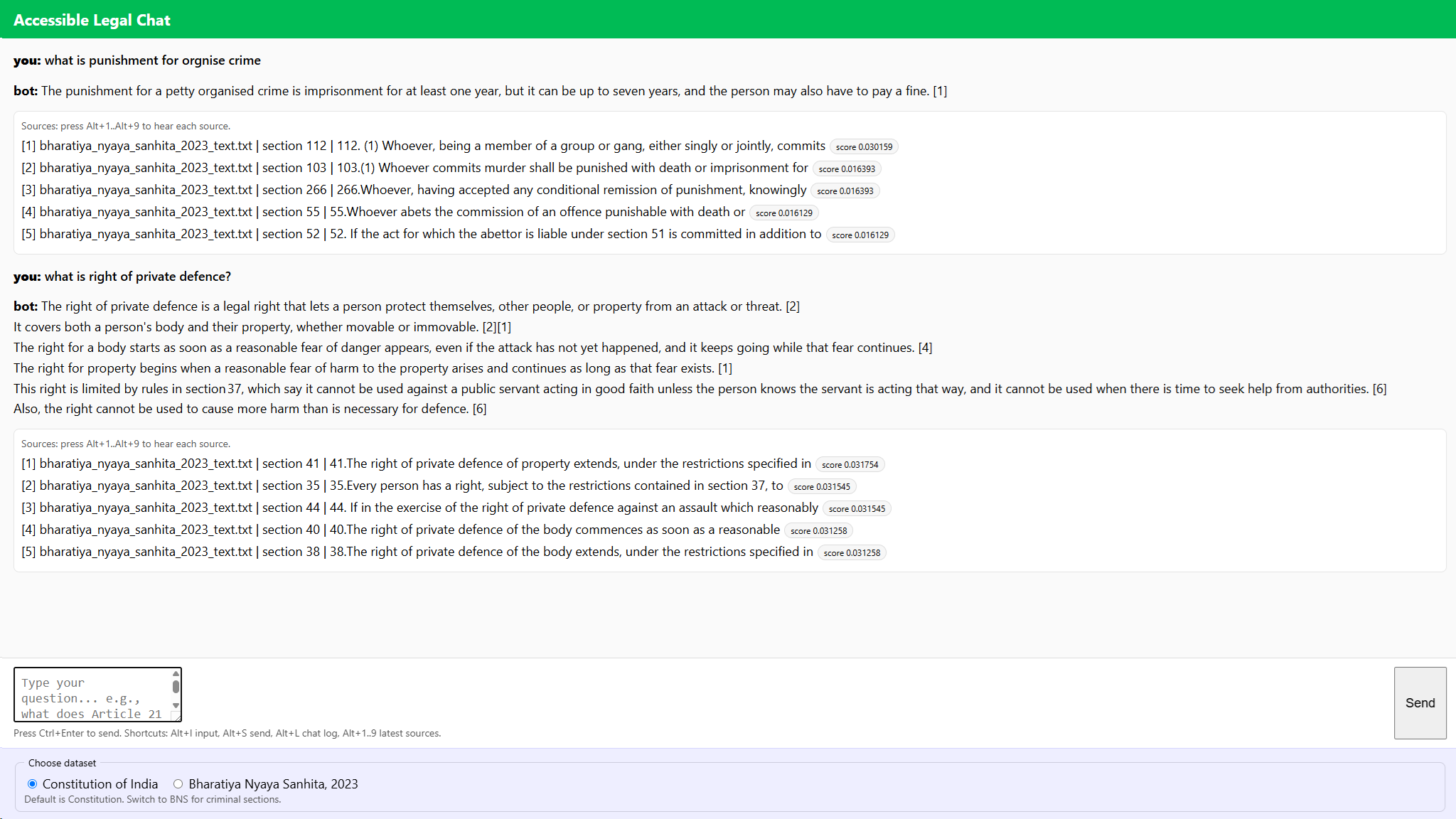
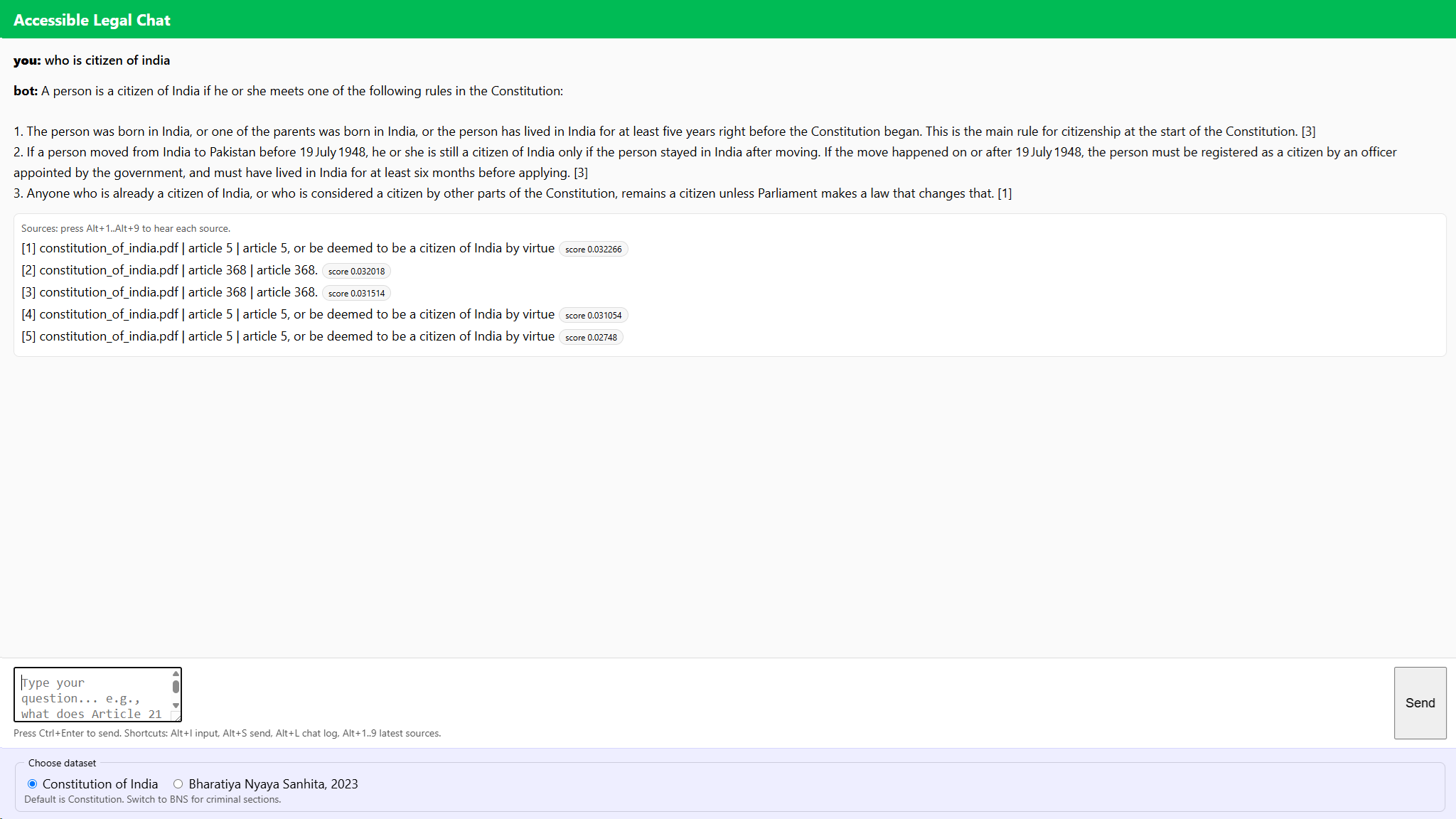
LawGPT is designed for people who need legal text explained clearly without losing the connection to the original source. It works with the Constitution of India and the Bharatiya Nyaya Sanhita, 2023.
Status: Portfolio case study
Problem
Legal documents are dense, formal, and difficult to search. Readers often need both a plain-language explanation and a reliable path back to the exact legal text.
Solution
The project combines direct statute lookup, hybrid retrieval, dataset filtering, and cited LLM responses. The interface is keyboard-first and screen-reader friendly.
Architecture
- Express and EJS render the interface.
- A retrieval layer combines regex lookup with hybrid search.
- Context blocks are passed to the language model with citation labels.
- The answer links back to source text blocks.
Technologies
Accessibility Review
- Keyboard shortcuts for query input, sending, chat log, and source references.
- Screen-reader optimized headings, source lists, and plain text fallback.
- Inline citations help users verify answers without visual scanning.
Challenges
- Maintaining legal source accuracy while simplifying language.
- Separating Constitution and BNS datasets reliably.
- Keeping citations aligned with retrieved context blocks.
Skills Demonstrated
- RAG pipeline design
- Node.js backend engineering
- Accessible interaction design
- Citation-aware response design
Outcome
The case study demonstrates accessible AI design, retrieval architecture, and practical source transparency for complex legal content.
Future Improvements
- Improve legal corpus coverage.
- Add more validation around citation consistency.
- Expand multilingual legal explanations after review.