Assistive Technology, Accessibility Engineering
DECtalk NVDA Bridge
Compatibility Layer for Modern 64-bit NVDA
DECtalk NVDA Bridge preserves access to a legacy speech synthesizer used by many blind computer users while adapting it for newer NVDA architecture.
Status: Completed and maintained for future NVDA releases
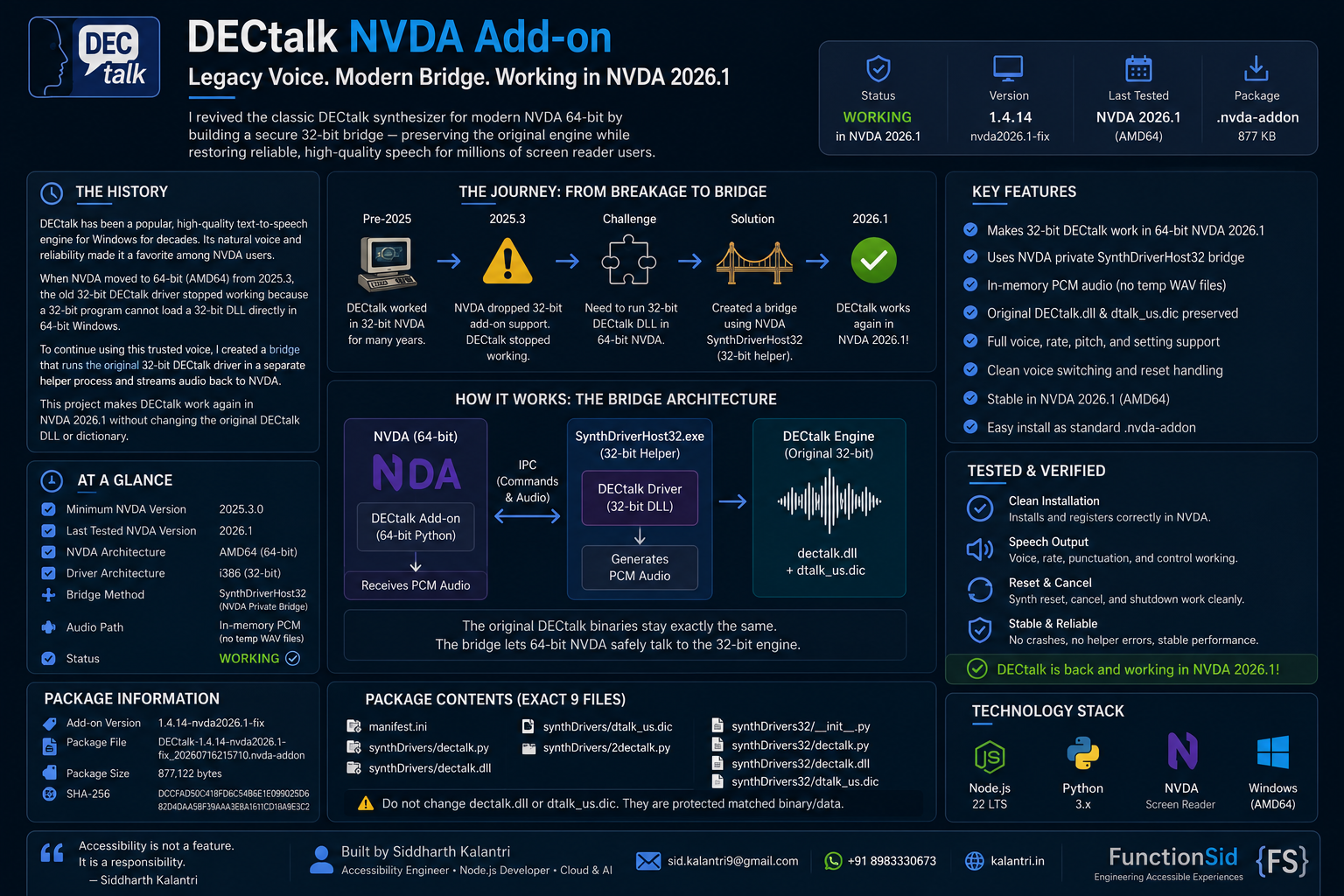
Problem
Modern NVDA releases require 64-bit compatibility, while the original DECtalk speech engine is a 32-bit Windows component.
Solution
The bridge keeps the original DECtalk engine untouched and uses NVDA SynthDriverHost32 to connect modern NVDA with the legacy speech component.
Architecture
- NVDA 2026.1 runs as the modern 64-bit screen reader.
- The 64-bit add-on communicates through SynthDriverHost32.
- The original 32-bit DECtalk engine produces speech output.
Technologies
Python
NVDA Add-on API
Windows
DECtalk
SynthDriverHost32
Accessibility Engineering
Accessibility Review
- Preserves a familiar speech option for blind NVDA users.
- Supports clean startup, shutdown, and stable speech output.
- Maintains compatibility without changing the original synthesizer.
Challenges
- Bridging 64-bit and 32-bit components.
- Understanding NVDA speech driver architecture.
- Testing across modern NVDA behavior while preserving legacy output.
Skills Demonstrated
- Accessibility engineering
- Legacy software modernization
- Python development
- Assistive technology testing
Outcome
The project restores DECtalk support on NVDA 2026.1 and demonstrates practical compatibility engineering for assistive technology.
Future Improvements
- Continue compatibility testing for future NVDA releases.
- Improve documentation for installation and troubleshooting.